

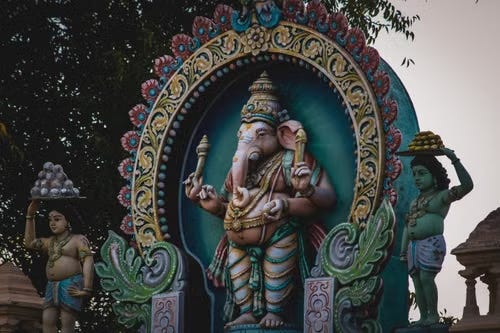
Well, good day.
As I part ways with trying to understand the Bible or defend why I don’t believe Jesus is God, I wonder where this leads me.
I write about my faith journey, psychology, and philosophy, so when I stopped believing in the Bible, I asked a friend, “What do I even write about now?”
He suggested taking a break. I wish I could, but I genuinely enjoy writing.
A couple of weeks ago, I went to the corner store for a few loosies. Over time, I’ve gotten to know the worker there, Casey, and I asked him what he practices; I’m always curious about how people apply their faith to daily life. He told me Hinduism, which resonated because I had dipped my toes into it a few years back.
Leaving Christianity left an undeniable void, and I wasn’t entirely sure how to navigate life without that old structure. There are a lot of old assumptions and fears I'm still untangling.
Intellectually, I know I don’t align with ideas like total depravity, predestination, or sacrifice-based rituals. But internally, the fear doesn’t disappear overnight.
So today, I bought the Bhagavad Gita. I’m listening to it and using AI as a tool to help me process its core premises. So far, it fits.
I can already hear old voices bemoaning me for looking elsewhere instead of submitting to Christ. But fear not, all paths lead to God. :D
Chapter 4, Verse 11, Krishna explicitly says: "In whatever way people approach me, in that same way I receive them. All paths lead to me."
Let’s take a look at Hinduism and what it is and isn’t.
Many Hindus refer to their tradition as Sanātana Dharma, often translated as 'eternal way' or 'eternal order.'
Because it views truth as universal and accessible to anyone, the mindset is simple: you don't "join" Hinduism; you simply begin practicing Dharma.
For many Hindu traditions, the emphasis is less on joining a belief system and more on living in alignment with Dharma.
Instead of a set of rules you must believe to avoid punishment, think of Hindu philosophy as a mindset for navigating reality.
These are my simplified notes after reading and discussing the concepts with AI.
1. You Have Two “Selves” (Purusha vs. Prakriti)
Prakriti (The Field): Your physical body, your emotions, your brain’s thoughts, and the physical world around you. It is constantly changing.
Purusha (The Observer): The quiet, eternal awareness inside you that watches the thoughts and feelings happen.
The Insight: This perspective suggests that anxiety belongs to the changing mind rather than to your deepest identity.
2. Energy Shifts in Real Time (The Gunas)
Your mind and the world move through three shifting states:
Sattva: Clear, peaceful, present.
Rajas: Driven, frantic, anxious, restless.
Tamas: Heavy, frozen, exhausted, numb.
The Application: You stop judging yourself for being exhausted or anxious. Instead of saying “I’m broken,” you notice: “My nervous system is in Tamas/Rajas right now,” and you take gentle steps toward Sattva.
3. Your Duty in the Immediate Present (Dharma)
Dharma isn’t a massive, grand destiny. It simply means doing the necessary, honest action right in front of you.
If you are hungry, your dharma is to eat. If you are exhausted, your dharma is to rest. It shrinks your focus down from “fixing your entire life” to just managing the next ten minutes.
4. Focusing on Input, Releasing Output (Karma Yoga)
Karma is action. Karma Yoga is doing your best on the input (your effort) while completely letting go of the output (the result, what people think, or how it turns out).
You hit “send” on the email or write your essay, and then you put the weight down.
Pretty cool. Now, compared with the form of Christianity I experienced, these ideas carry far less shame and guilt.
I’ve found that by understanding and applying and even learning, theology became burdensome.
Here’s my recent confusion: Ezekiel chapter 18 says the sins of the father cannot be passed to the son. Like the son cannot inherit the sins of his father.
If we understand that concept in Ezekiel, then how do we reconcile the sins of Adam being inherited into my life? I didn’t disobey God in the Garden. Why should I be held accountable for the sins of Adam?
I've asked several people this question and received different answers. Perhaps there's a satisfying reconciliation. I simply haven't found one yet.
Just to be clear, I’m not converting to Hinduism; I’m curious, and I’m exploring other faiths in my life. In the past, I wrote about Judaism, and I appreciate their philosophy and their history. However, I’m not converting to Judaism.
If I'm honest, I felt the need to clarify that because part of me still expects to be judged for looking outside Christianity. Old beliefs don't disappear overnight. Even when your mind changes, your nervous system often takes much longer to catch up.