

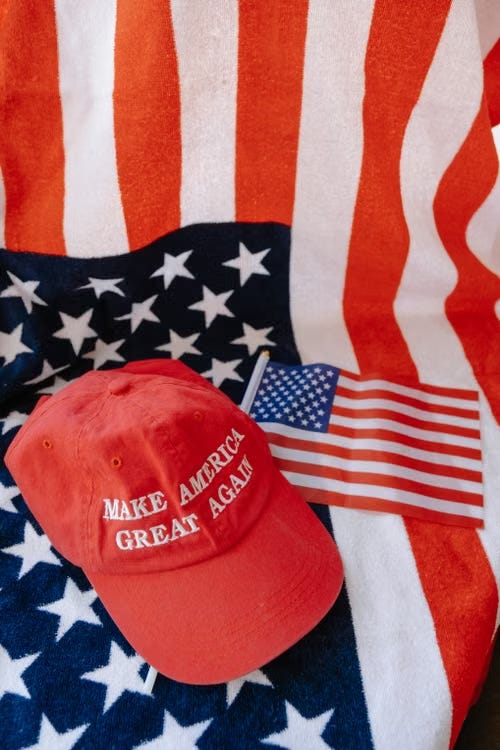
It’s been a long time coming, but after years of believing Donald Trump was the savior of America, I’m calling my past position in Republican politics for what it was.
I’m denouncing my past support for Donald Trump, once and for all.
It’s wild to admit, but I denounced Jesus before I ever did with Donald Trump—as if Trump was somehow better or more worthy of my loyalty.
I could spin a whole narrative to explain why I voted for him in 2016 and 2024:
I could blame my religious background and the drive to stay conservative.
I could blame living in North Carolina in the heart of the Bible Belt.
I could blame the influence of older friends I thought knew more than I did.
I could blame my time at Liberty University in my early twenties.
To be completely honest? I was a sheep. Hook, line, and sinker.
Donald Trump got my vote because I fully identified with the Christian Nationalist movement. But Christian nationalism isn’t about private faith, personal prayer, or trying to live out the Golden Rule. It is a political movement that uses religious identity as a blueprint for who gets to hold power.
Faith vs. Empire
Christianity is a global faith focused on spiritual practice, personal morality, and community service.
Christian Nationalism is a political ideology focused on state power, national borders, and legal dominance—claiming a country belongs exclusively to one group and enforcing their worldview on everyone else.
The Three Marks
Preserved Privilege: Demanding that Christian symbols, prayer, and doctrine hold protected status in public schools and courtrooms above all other perspectives.
Exclusive Patriotism: Treating national identity as inherently religious, viewing anyone outside the faith as a guest rather than an equal citizen.
Providential Myth: Framing political victory as a sacred duty under a divine contract rather than a basic civic process.
When faith shifts from transforming the human heart to capturing political power, the focus changes from serving others to controlling them. It trades personal integrity for legal coercion.
I chose to ignore his character because I held onto his promise of what he’d deliver—especially regarding “Christian freedom.” In reality, Trump is far worse than Jesus. But today, I reject both equally.
Moving Beyond the Labels
Now that I have reoriented my mind to practice non-belief, my politics have to follow. But I have a pet peeve in this space: I hate labels.
Denouncing Trump doesn’t make me a Democrat, and I’m damn sure not a Republican. I have zero interest in trading one set of dogmatic party rules for another. I don’t want to label myself today.
What I do want is a political worldview that operates without the belief in God—one that relies on empirical evidence, human dignity, and personal freedom. As I deconstruct both my faith and my politics, I find myself pulling from three primary frameworks:
Secular Humanism: Placing ethics, reason, and human dignity at the center. It insists that laws should be grounded in observable evidence and shared civic needs rather than scripture, serving the tangible well-being of everyone regardless of what they believe.
Civil Libertarianism: Prioritizing personal autonomy and individual freedom. It rejects the government enforcing moral codes, viewing any attempt by a religious majority to dictate how people live, love, or think as an absolute overreach of power.
Secular Liberalism: Protecting a neutral public square through equal protection under the law. It demands a strict wall between church and state so no single religious agenda can capture political power to subjugate others.
I’m not slapping a new party badge on my chest today. I’m just choosing to navigate the world with clear eyes—using reason, human empathy, and real-world evidence as my compass instead of ancient texts or political idols.
If you’re out there untangling yourself from old beliefs or political identity, know that you don’t have to rush to pick a new team today. Take a breath, trust your own mind, and let reason and empathy lead the way.
Until next time, Barnaby.