


“Hey guys — to those of you who know me, thank you for your time and company over the years.
I’ve decided that I no longer believe in the New Testament or practice Christianity, so I will no longer be attending Cornerstone. I may stop by occasionally since my family goes there, but as far as my own involvement, I’m stepping back.
Thank you for reading my thoughts over the years. I’ll stop texting the main group after this, but if anyone wants to reach out directly to understand where I’m coming from, my line is open. Take care.”
I had to draw a firm line the other night. I couldn’t keep pretending or living under the illusion that I’m a Christian when I don’t believe in Jesus as deity or practice the faith.
Right now, I’m examining the mechanics of modern Christianity. People interpret the Bible through many lenses, but today I am laying out a side-by-side forensic look at the two primary ways Jesus’ identity is interpreted: Trinitarianism and Unitarianism.
The Core Question:
Is Jesus the Almighty Creator taking on Human Flesh (Trinitarianism), or is He a distinct human messenger fully authorized to act on God’s behalf (Unitarianism)?
1. Trinitarianism: The Case for Deity
Trinitarians argue that Jesus shares the divine identity, essence, and authority of Yahweh.
Pre-Existence & Creation (John 1:1, Colossians 1:16–17):
Argument: “The Word” (Logos) isn’t just an idea; it’s a person who existed before time and created all things. In Isaiah 44:24, Yahweh says He created the universe alone. If Colossians says everything was created through and for Jesus, Jesus must share Yahweh’s divine nature.
The “I Am” Claims (John 8:58, John 10:30):
Argument: When Jesus says “Before Abraham was, I am,” he invokes the divine name from Exodus 3:14. The crowd immediately picked up stones for blasphemy because they understood he was claiming to be God.
Exercising Divine Prerogatives (Mark 2:5–7, John 9:38):
Argument: Jesus directly forgave sins on his own authority (which only God can do) and accepted worship (proskuneo). In Scripture, angels reject worship (Rev 22:8–9), but Jesus accepts it.
Applying Yahweh Texts to Jesus (Philippians 2:9–11, Hebrews 1:8):
Argument: Paul applies Isaiah 45:23 (“To me every knee shall bow”) directly to Jesus. In Hebrews 1:8, the Father Himself addresses the Son as God (Theos).
2. Unitarianism: The Case for Absolute Monotheism
Unitarians read the text through ancient Jewish monotheism, arguing Jesus is a human messenger, prophet, and agent—not Almighty God.
Explicit Distinctions Jesus Makes (John 17:3, Mark 10:18, Mark 13:32):
Argument: Jesus explicitly calls the Father “the only true God” (John 17:3) and deflects ultimate goodness to God alone (Mark 10:18). Furthermore, Jesus admits he does not know the time of his return—if God is all-knowing, but Jesus had limited knowledge, Jesus cannot be God.
The Ancient Law of Agency (Shaliach):
Argument: In Jewish law, an authorized agent (Shaliach) acts with the full power and authority of the principal (“A man’s agent is as the man himself”). Jesus forgiving sins and performing miracles is not proof he is God, but proof he was fully authorized by God (John 5:19, 30).
Apostolic Teaching (1 Timothy 2:5, Acts 2:22):
Argument: Paul specifically calls Jesus “the man Christ Jesus” who mediates between humans and the “one God.” In Acts 2:22, Peter introduces Jesus not as God in the flesh, but as “a man accredited by God.”
Logical & Theological Contradictions:
Argument: Scripture states God cannot be tempted (James 1:13) and cannot die (1 Tim 6:16). Yet Jesus was tempted (Hebrews 4:15) and died. If God died, the universe collapsed; if only a “human nature” died, then a human saved us, not God.
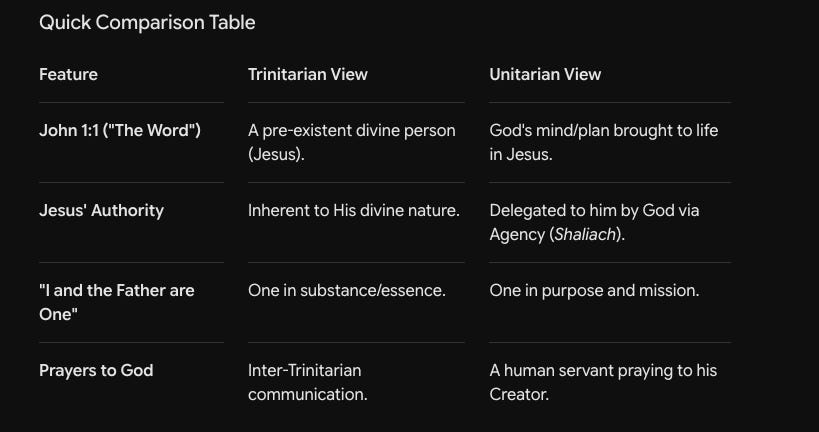
When you lay both arguments side by side without church tradition dictating the answer, you can see why this debate has lasted two millennia:
Trinitarians attempt to harmonize passages in which Jesus performs divine acts by positioning a multi-person Godhead.
Unitarians preserve strict Old Testament monotheism, viewing Jesus as the exalted human representative of Yahweh.
My goal isn't to tell you what to believe, but to lay both interpretations side by side so you can examine the text and the reasoning behind each one.
I no longer accept the New Testament as binding authority in the way I once did, though I continue to study it and wrestle with its claims.
Maybe one day I’ll land somewhere where I do believe, but right now I’m wrestling.
I’m starting at ground zero, and I don’t believe Jesus is God; I lean more towards Unitarianism.